- HomeHome
- DiningDining
- Venues & EventsVenues & Events


QT Talks To: Nangaw, Taronga Zoo’s One Winged Owl
 Share
Share


 Share
Share
By Benjamen Judd
No matter how old or young, or how often you may visit, Taronga Zoo instils a deep sense of wonder in everyone who walks through their gates.
Of course, once you’re through those gates the ensuing debate over what to see first can often make even the bestest buddies see red. But here at the QT, we can all agree that first stop is the birds.
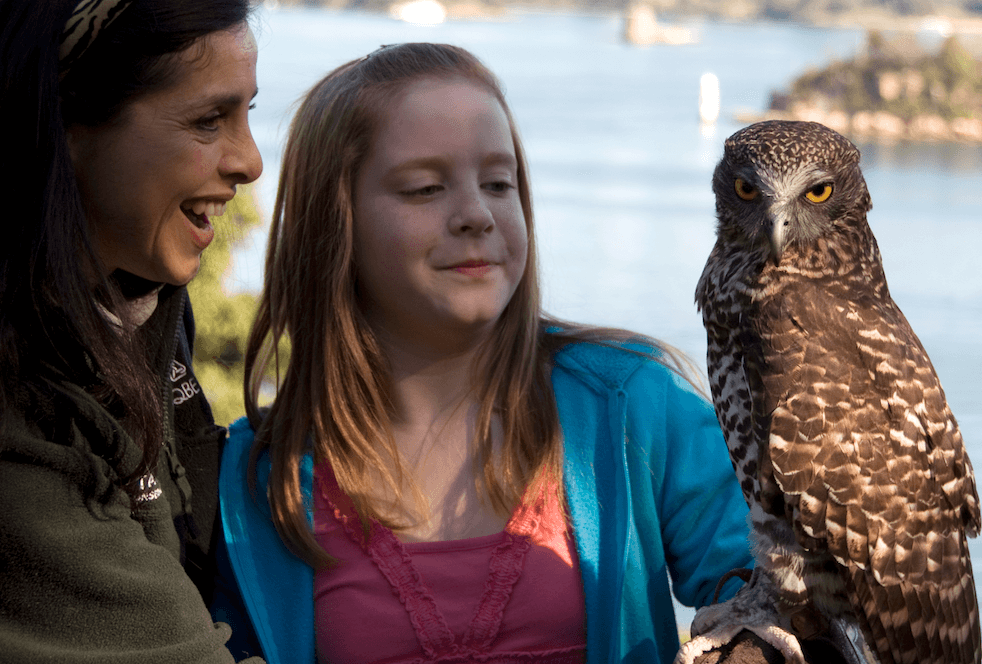
Eagles, hawks, vultures – they capture the imagination like nothing else. But one bird in particular holds a special place in our hearts – Nangaw, the One-Winged Powerful Owl.
We got the chance to chat to Nangaw’s keeper and all-round awesome dude, Grey Fisher and ask him a little more about our favourite one-winger and his role at Taronga Zoo.
Hi Grey, thanks for taking the time to chat with us. Can you tell us how did Nangaw first come to live at Taronga Zoo?
When owls are growing up they go through a stage before they can fly called branching. It just means they don’t stay in their nest anymore but start climbing around in the tree. At this time it’s really common for birds to fall out of the tree. Usually the parents just look after them on the ground, or if it’s a rough barked tree they can just climb back up to the next.
Unfortunately for Nangaw there was barbed wire fence under her tree and she got stuck in that. Her tree was behind a primary school and the maintenance workers found her stuck. They called WIRES who then freed her from the fence and brought her here to be treated at the Taronga Wildlife Hospital. The injury to her right wing was so severe that it had to be removed. She’s been here ever since as, due to her injury, she wouldn’t survive if we released her back to the wild.
Can you tell us about the process it took to become Nangaw’s handler?
Originally I was her only trainer when she first arrived. I did all the work with her. But now that she’s older and more comfortable, all of us on staff work with her pretty equally so she’s got a family of 7 helping her out now.
Allocation of an animal depends on experience of the staff and animal. Also on interest level. Owls are my favourite so I tend to go for all the owl projects that I can.
What kind of training you undertake to be able to really help Nangaw?
I’ve been working in Zoos and other animal facilities my entire life. Birds have always been my strongest interest.
I started training birds back in the states 10 years before I came here, and I’ve been here 10 years, so 20 years now. I’ve never worked a bird in exactly her situation where the wing was entirely missing. I’ve worked with birds that had partial amputations or just broken wings that they couldn’t use properly but were still there. I’ve not worked with one as extreme as her before but I’ve had other similar cases. In a lot of ways she is easier because it happened before she was flying. So she adapted remarkably quickly. Flying is not an instinct for her.
What kind of rehabilitation process did Nangaw go through once at Taronga Zoo?
She didn’t need a whole lot of rehab. Animals adapt quickly to changes in their physiology. Her only real issue is balance as she tends to lean a little bit to compensate for the loss of the wing. She lost her wing before she would have ever been flying so she doesn’t have a concept that having one wing isn’t what life is supposed to be life.
What sort of activities do you and Nangaw do to help foster your relationship?
It’s all about food!
She was a young bird who would have still been fed by parents when she came in so I took on that role. She obviously wouldn’t be able to catch food on her own unless it was really slow or not very smart. So she was never going to learn to feed herself, so I took that role on myself.
That is honestly how we began the relationship. She learned very quickly. Humans had been scary to her up to that point, so I had to build that relationship by taking on the role of food provider. Same roll her parents would fill. It happened pretty quickly – her training went very fast. I wanted to make sure she could be exposed to as much as possible as young as possible. I used to just walk her around the Zoo, and walk to the offices to have a chat and took her to visit classrooms at the education centre, so she would be used to meeting people for encounters. All of those new experiences I paired with food. As long as she knew that guy with food was there she knew she was safe.
What should someone do if they find their own injured Nangaw?
Calling WIRES is the best thing to do if they’re in the WIRES region. Every area has a wildlife rescue. They’ll send someone out to look after it.
Nangaw is now 9 years old and works at the Taronga Zoo Bird Show. She does encounters with our guests. During her time there she’s met guests, celebrities and school groups as an ambassador for her species.
QT Social
Feeling a little social? Follow QT
 Turn on notifications and be the first to know when exclusive deals and limited-time offers drop. View privacy policy
 Powered by
 Enter your details
 - DiningDining


Book
 Close
Search
Close
Search